


Spoiler Warning: We are spoiling The Avengers and the entire MCU continuity. If you aren’t caught up, or don’t want Avengers: Doomsday to be spoiled (even though I have absolutely no idea about what will happen in that movie) stop reading now or accept the risks.
Partnered with the Chitauri (alien muscle), Loki steals the Tesseract from S.H.I.E.L.D. and uses his scepter (which we find out in a later movie contains the Mind Stone) to control Dr. Selvig and several other agents, including Hawkeye, to help him conquer Earth. Nick Fury reactivates the “Avengers Initiative,” gathering up Captain America, Iron Man, Bruce Banner, Natasha Romanoff, and Thor (who shows up because his brother, Loki, is the one trying to conquer Earth). Hawkeye will later join the team rounding out The Avengers, but he first has to be relieved from the mind control of Loki. There are initially some smartass comments and familial bickering amongst the heroes, but after Agent Phil Coulson is killed by Loki, Nick Fury shamelessly uses his death to unite the heroes (he even lies about Coulson’s bloodsoaked cards being in his pocket when he was killed when they were actually locked away in his locker—but it worked). The Avengers finally team up to fight Loki, who opens a wormhole above Stark Tower and launches a full invasion of New York with the assistance of the Chitauri (which becomes known as The Battle of New York—hugely important later in the MCU). The World Security Council decides to fire a nuclear missile in the middle of Manhattan to stop the invasion; Tony Stark has to redirect the warhead to the wormhole to destroy the Chitauri mothership at the same time that Black Widow steals Loki’s scepter and seals the portal. Tony seems to sacrifice himself by guiding the missile through the wormhole, but he falls through right as the portal closes. Loki is captured and taken back to Asgard, and The Avengers have established themselves as Earth’s mightiest heroes.
The Avengers isn’t the introduction to any major character (with the exception of Hawkeye), so I couldn’t figure out why this movie would be on the watchlist that Marvel put out—until I really started to dig into it, and really started to think about who the film was actually about. While The Avengers is a film about Earth’s mightiest heroes, the main character is, and has always been Tony Stark (notice how I say Tony Stark and not Iron Man—even though they are the same character). That is why The Avengers is homework, to leave breadcrumbs (even if they are post factum) about the parallels between Iron Man and Doctor Doom.
That’s not to say the Iron Man/Doctor Doom parallels are the only useful things to know going into The Avengers: Doomsday—the film seamlessly balances vastly different genres and characters into one cohesive narrative, and the Battle of New York is a seminal moment in the entire MCU, often referenced in future MCU films. But understanding Tony Stark’s obsessive need to “put a suit of armor around the world” and Doom’s authoritarian pursuit of universal control, retroactively makes sense of Marvel’s decision to cast Robert Downey Jr. as Doctor Doom.
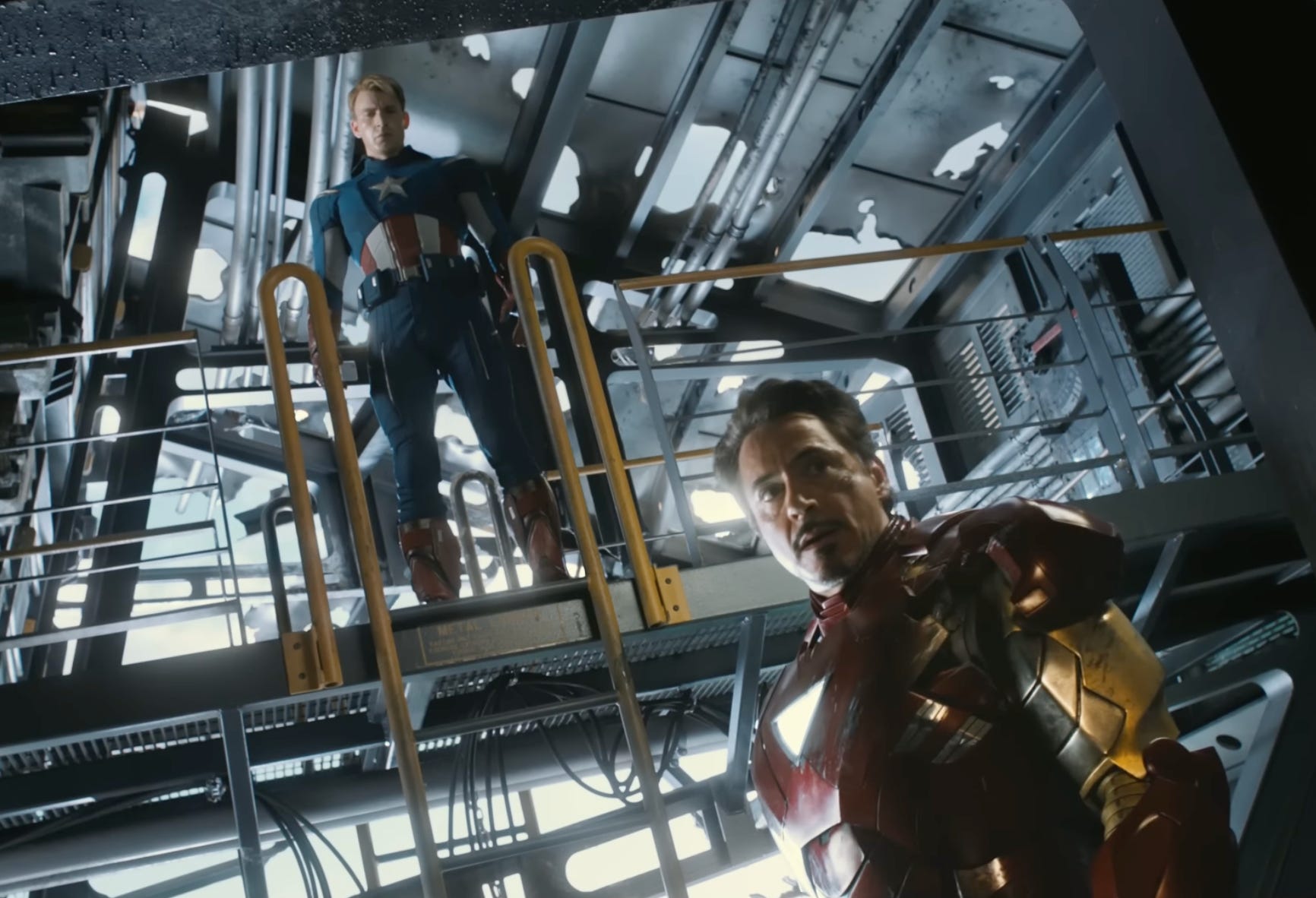
Tony Stark’s driving force in the MCU evolves from a profound sense of guilt to a limitless need to protect the world (especially since he thinks he is—if not the only—definitely the best one to do it). Doctor Doom (in his comic history) has an unshakeable conviction that he is the only person in the world that has the intelligence and vision to save (by ruling) the universe. Tony believes he can fix everything on his own. There’s a point in The Avengers where Steve challenges Tony, “You’re not the guy to make the sacrifice play, to lie down on a wire and let the other guy crawl over you.” Tony simply responds, “I think I’d just cut the wire.”
Not only does this interaction paint a clear picture of the difference in philosophies between Steve Rogers and Tony (with Steve being altruistic, and Tony more pragmatic), but it also gives a hint as to Tony’s nature to outsmart, rewrite, or break the rules of the system to win. Doom is someone who views compromise as failure and reshaping reality itself as the only logical solution to existential threats. There is a thin line between Tony’s stubborn pragmatism and Doom’s absolute authoritarianism.
The ironic thing is (unless you have no knowledge of modern movie tropes) that while Steve told Tony he wouldn’t “lie down on the wire”, Tony’s selfless act of guiding the nuclear missile through the wormhole actually parallels the exact sacrifice that Steve made in The First Avenger (jumping on the dummy grenade). The even more ironic thing is (even if you have plenty of knowledge of modern movie tropes), the moment when Tony flies the missile into the wormhole and sees the alien army is where his control-obsessed mindset that mirrors Doctor Doom is born.
The Avengers is a groundbreaking movie that blends multiple genres and takes heroes from four of their own distinct movies and seamlessly weaves a cohesive, emotional narrative. But it is more than just that. It is the origin of Tony Stark’s belief that he has an obligation to protect the world. When Marvel put The Avengers on the Doomsday watchlist, I don’t think it was to introduce us to the Avengers, but to retroactively draw parallels between Tony Stark and Doctor Doom. The announcement of Robert Downey Jr. as Doctor Doom might have been a gimmick to revitalize the MCU, but Marvel has done a good job of not only making it make sense, but showing how it could have been the plan the whole time.
Disclaimer: All images and characters are the property of their respective copyright holders and are used here under Fair Use for analysis and commentary.