


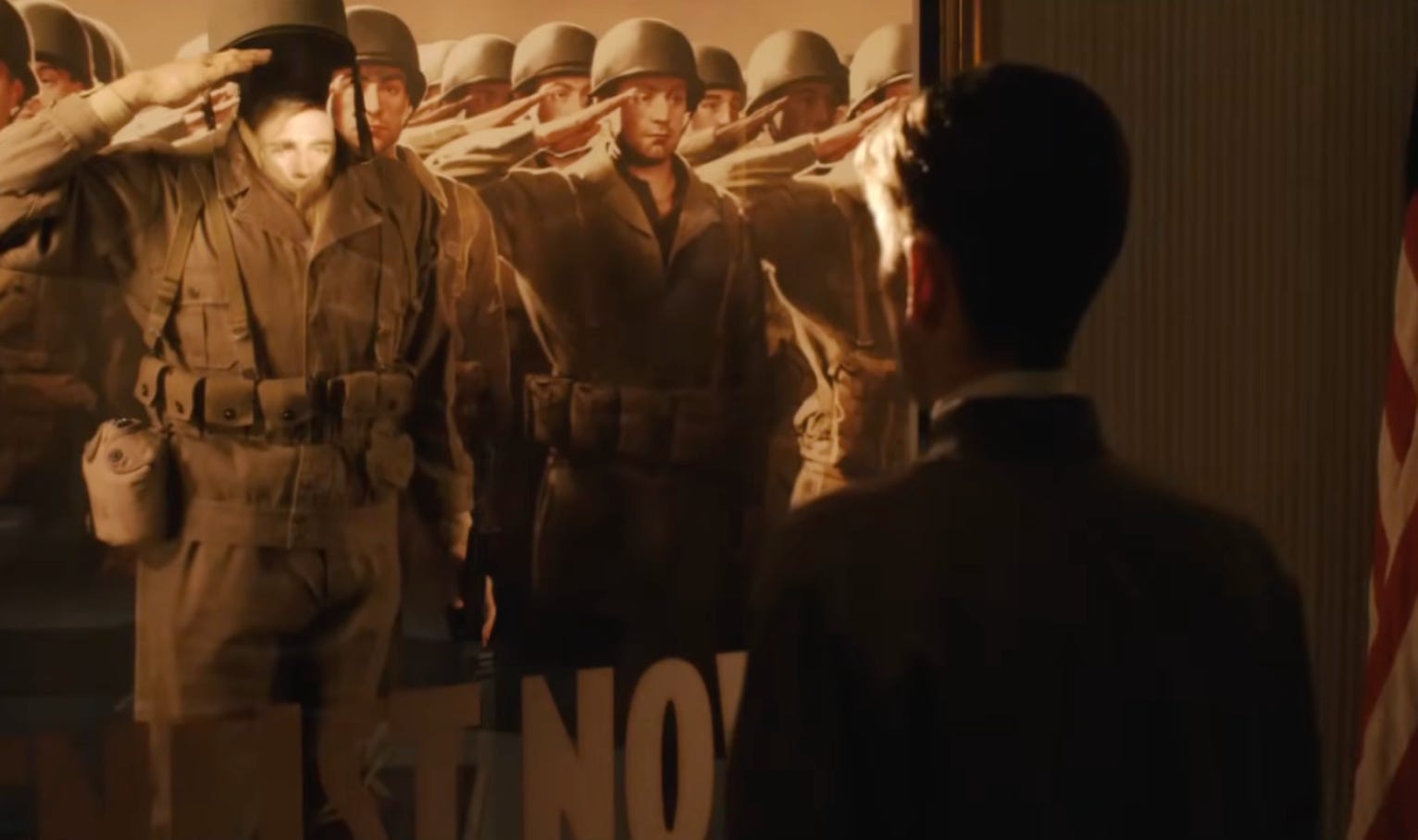
Spoiler Warning: We are running through full character and plot details, as well as franchise connective tissue for Captain America: The First Avenger, and the entire MCU continuity. If you haven't seen the movie (or don’t remember it, or don’t want Avengers: Doomsday to be spoiled—even though I have absolutely no idea about the plot and character details of that movie) stop reading now or accept the risks.
After playing in the old Fox sandbox for a few weeks… welcome to the MCU! While there will definitely be some characters from the Fox/X-Men universe, I don’t think the stories from either of those two movies will have much to do with Doomsday, but that probably changes with Captain America: The First Avenger. Yes, it was actually the fifth film in the new Marvel Cinematic Universe, with characters from all four of the previous films confirmed (kind of) to be in Avengers: Doomsday (not Iron Man, but RDJ as Doctor Doom, and not Edward Norton as Hulk, but Mark Ruffalo as Hulk), but the character of Captain America (and the events of his movie) seems to have the biggest connection to Doomsday.
I’m taking nothing away from Iron Man (the character or the movie), and while the movie is awesome and set the tone for the MCU, it didn’t quite feel like a cohesive ecosystem until Captain America. I submit that this is a result of the connective tissue from the previous four films, but there is a reason why the title is Captain America: The First Avenger—because even though Iron Man, Hulk, and Thor were all already introduced on screen, in the (sacred) timeline, Captain America was introduced to the world in the 1940s, making him the true start of the MCU.
Let’s run through The First Avenger: In a present-day prologue, S.H.I.E.L.D. finds Captain America’s shield in the Arctic ice. Then the movie really starts; in 1942, Nazi commander Johann Schmidt (aka Red Skull) retrieves the Tesseract (an artifact that contains infinite energy—also the Space Stone later in the MCU); small and skinny Steve Rogers is repeatedly rejected from the military, his best friend (Bucky Barnes) gets deployed, Steve lies, gets in, shows bravery and smarts (jumping on a dummy grenade to protect other soldiers and unscrewing a flagpole to retrieve a flag), gets chosen by Dr. Erskine to take the super soldier serum (made possible by Howard Stark), and gets big and strong. Dr. Erskine is immediately killed by a HYDRA assassin, so Steve isn’t allowed to soldier (after literally becoming a super soldier), then he goes on a USO tour as “Captain America.” While on tour he learns that Bucky is in trouble and he goes to save Bucky. Steve saves him then recruits him and his unit to the Howling Commandos to fight against HYDRA and find Commander Schmidt and Dr. Zola; Howard Stark provides Steve with his famous shield made out of vibranium. They find Dr. Zola, who breaks and tells them where Schmidt is and they go after him. There’s a big battle, Steve boards The Valkyrie (a huge flying craft), fights with Schmidt, then Schmidt is sucked into space when he grabs the Tesseract with his bare hand (the Tesseract burns through the floor to the bottom of the ocean). Steve is on The Valkyrie which is on autopilot set for New York to blow it up and he can’t get off without letting it get to New York. He sacrifices himself and guides the craft into the Arctic ice (remember the prologue?). Steve wakes up in modern-day New York and Nick Fury tells him he was in the ice for 70 years.
Steve Rogers’ character makes him the ideological center of the entire MCU. 70 years ago (on the sacred timeline) Dr. Erskine told Steve:
“This is why you were chosen. Because the strong man who has known power all his life may lose respect for that power, but a weak man knows the value of strength, and knows compassion... Whatever happens, promise me one thing: that you will stay who you are. Not a perfect soldier, but a good man.”
Before taking the serum, Steve wasn’t the biggest (probably the smallest) or the strongest (probably the weakest), but he had the biggest heart. He would risk his life for the lives of others. He made it clear, no matter the circumstances, that you don’t trade lives (he wasn’t willing to give up a life, any life, to save another life); he put the safety and well-being of everybody else before himself; he was the most loyal friend; and he would take beating after beating, without ever running and hiding, reminding whoever was on the delivering end of that beating, “I can do this all day.” That became the mantra of Steve Rogers (they even made a musical about it in the show, Hawkeye), and it signified the basic principle that he would never quit.
Dr. Erskine had some bangers—he also said, “The serum amplifies everything that is inside, so good becomes great; bad becomes worse.” This is the crux behind his philosophy that power amplifies a person’s inner nature. This is literally the difference between a hero and a villain (or in some instances, an anti-hero). Steve wasn’t the biggest or strongest before he took the serum, most people actually thought he was too weak to even be a consideration for the serum, but Erskine saw something else. He saw who Steve was, which meant that he saw who Steve could become.
For Doomsday to hit the way it needs to (emotionally, not physically), it is narratively essential for the MCU to ground the conflict in a personal, character-driven moral framework established over a decade ago in The First Avenger. Steve was on one end of that framework (his pre-serum character made him the ideal person to be a hero… or was he a hero even without the serum?) and I imagine that Doctor Doom will be on the opposite end of that spectrum.
Disclaimer: All images and characters are the property of their respective copyright holders and are used here under Fair Use for analysis and commentary.