


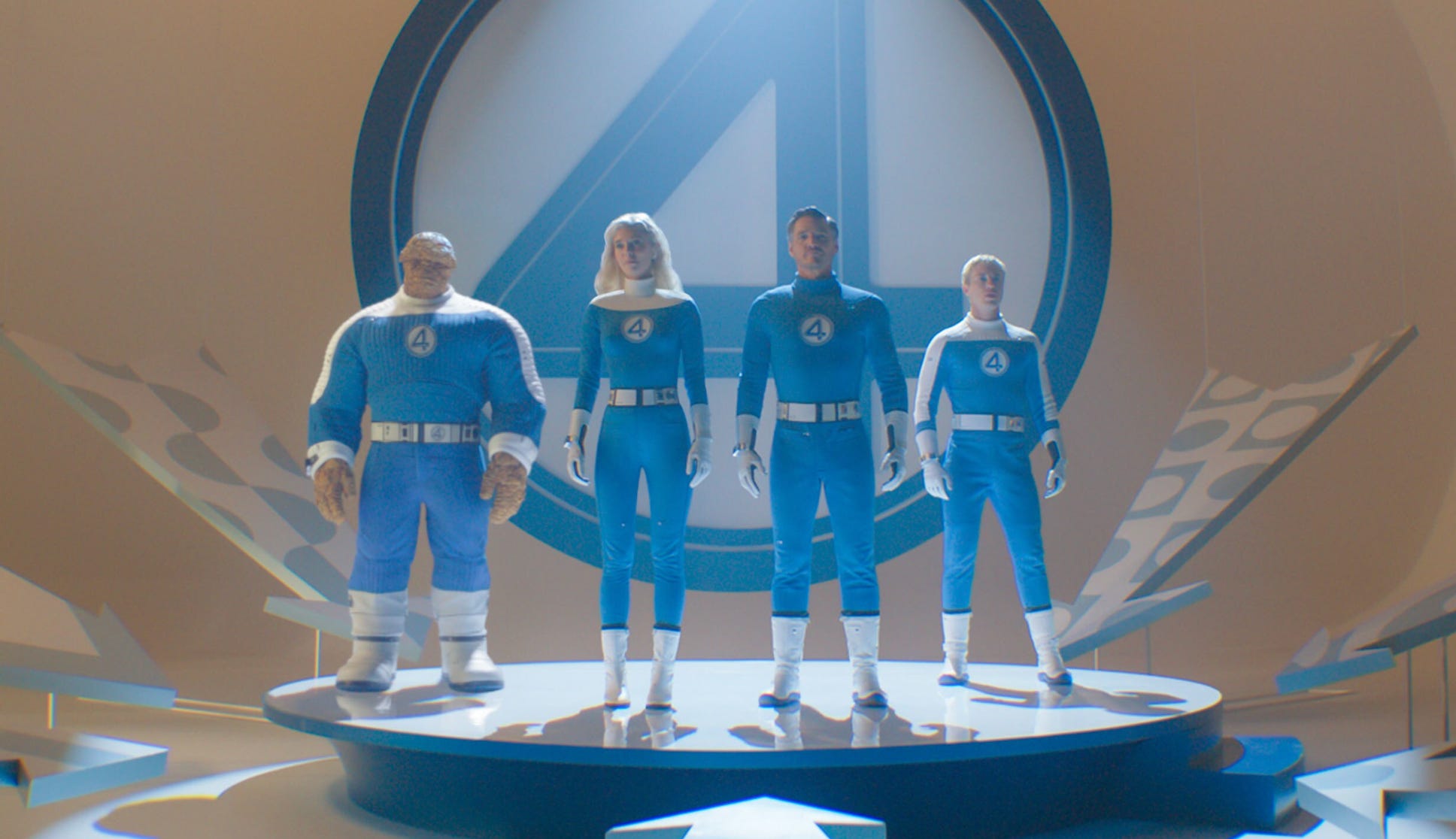
Spoiler Warning: We are spoiling The Fantastic Four: First Steps and the entire MCU continuity. If you aren’t caught up, or don’t want Avengers: Doomsday to be spoiled (even though I have absolutely no idea about what will happen in that movie), stop reading now or accept the risks.
The Fantastic Four: First Steps is essential preparation for Avengers: Doomsday because it introduces one of the primary hero teams (one from Earth-828) and the catalyst at the center of Doctor Doom’s multiversal ambitions (whatever they might be beyond having worlds destroy each other). The film being set in the 1960s of an alternate universe was an interesting choice, but it made their introduction to the MCU actually make sense (it would be hard for them to be Marvel’s First Family if they were like the 123rd heroes introduced to this world). It also allowed the film to bypass modern superhero (and world) cynicism by reclaiming the earnest wonder of the Space Race (presenting a utopian society where human inventiveness and civic cooperation know no limits). But we know what they don’t know… that there are always limits.
On 1960s Earth-828, the Fantastic Four (Reed Richards, Sue Storm, The Thing, and Johnny Storm) are Earth’s only superheroes and global peacemakers. Reed and Sue learn they are expecting a baby just before Shalla-Bal (Silver Surfer) arrives and lets the world know Earth will be consumed by Galactus (a celestial being that eats planets). Traveling to space to negotiate with Galactus, they refuse his demand to trade their unborn child for Earth’s survival. They are then chased by Shalla-Bal, escape, and Sue gives birth (in the spaceship) to Franklin Richards. Reed enrages the whole world when he lets them know what Galactus’s demand was (giving up his newborn child), and Sue has to get the people back on their side with an impassioned speech that reunites humanity. Reed then rallies nations to build teleportation bridges to move Earth (yes, the whole planet) out of Galactus’s path. Shalla-Bal destroys most of the bridges before Johnny appeals to her conscience (those Storms really can get to people’s hearts and minds) by reminding her why she sacrificed herself to save her daughter. They lure Galactus to a Times Square portal on Earth, but there really isn’t a battle as much as Galactus just destroying the city. Sue uses that Mom-strength to push him through the portal when Shalla-Bal sacrifices herself for the final push. Sue dies, but is quickly resurrected by baby Franklin’s insane powers (that probably has a little something to do with why Doctor Doom wants him). Four years later in the post-credits scene, Sue walks in on Doctor Doom holding a metal mask next to young Franklin.
The main conflict of the movie is the fact that Earth has been marked for consumption by Galactus (a universal force as inevitable as the stars). This message is delivered to the world by Shalla-Bal, who seems to be slightly empathetic with humans, urging them to spend their final days holding their loved ones. She is the messenger, but she is not gloating; rather, she speaks with detached inevitability. The Fantastic Four spend the film trying to avoid this inevitability by leaning into the inventiveness and cooperation that they felt could solve any and all problems (at one point they convince the entire world to follow a curfew so they could harness enough power to implement their plan). It works, to an extent. They create the portal that they eventually send Galactus through, but they need Shalla-Bal to sacrifice herself to make it happen. Then Sue dies and has to be brought back to life by her infant son. Throughout the entirety of the movie (especially their original plan of moving Earth), Doctor Doom looms large. Reed’s plan to teleport Earth to another Solar System seems like something that could be important when trying to save the world in Doomsday, and Franklin saving Sue hints at why somebody like Victor von Doom might want him so badly.
And Doom isn’t even in the actual movie (he doesn’t show up until the post-credits scene). But I digress, because he is THE villain of the Fantastic Four. He is to the Fantastic Four as Lex Luthor is to Superman (different universes, same meaning), as Green Goblin is to Spider-Man, as Magneto is to Professor X. So him not really being in this iteration of the Fantastic Four was a bit surprising, until we found out that he was basically getting his own movie (Doomsday). Then, his cameo in this movie directly launches the narrative connection to Avengers: Doomsday when Victor von Doom shows up with Franklin Richards—possibly the most powerful character in Marvel history—hinting at the fate of Earth-828 (for whatever reason, they do escape it and end up on Earth-616 in Thunderbolts*). Maybe the entire multiverse hinges on the collision between Doom and this family of heroes. We will find out in Doomsday.
Disclaimer: All images and characters are the property of their respective copyright holders and are used here under Fair Use for analysis and commentary.