


Spoiler Warning: We are spoiling Doctor Strange in the Multiverse of Madness and the entire MCU continuity. If you aren’t caught up, or don’t want Avengers: Doomsday to be spoiled (even though I have absolutely no idea about what will happen in that movie), stop reading now or accept the risks.
I don’t like scary movies. Never have, never will. It all started when I watched Nightmare on Elm Street at like four years old (I had nightmares for months). My family still makes fun of how uncomfortable Freddy Krueger and his stupid horizontal striped sweater make me (...very). So you can imagine I wasn’t super stoked when I heard Sam Raimi was going to direct Multiverse of Madness (I know he directed the three original Spider-Man films, but he is best known for directing horror, and this film was supposed to be the MCU’s first foray into horror). The movie wasn’t that scary, but it did have moments (some of which still cause me not to watch it alone… or in the dark… or right before bed).
I had to risk months of nightmares to watch this film again when it was announced as essential viewing in preparation for Doomsday. The movie goes deep into the mechanics of alternate universes, variants, and the consequences (and difficulty) of crossing between realities. Multiverse of Madness introduces the concept of incursions (events where universes collide and destroy one, or both, entirely), which sounds like it will be the foundation of the entire plot of Doomsday. By establishing how multiversal travel works, and how dark magic can unravel reality, this film is crucial for understanding what the MCU’s collapsing multiverse means.
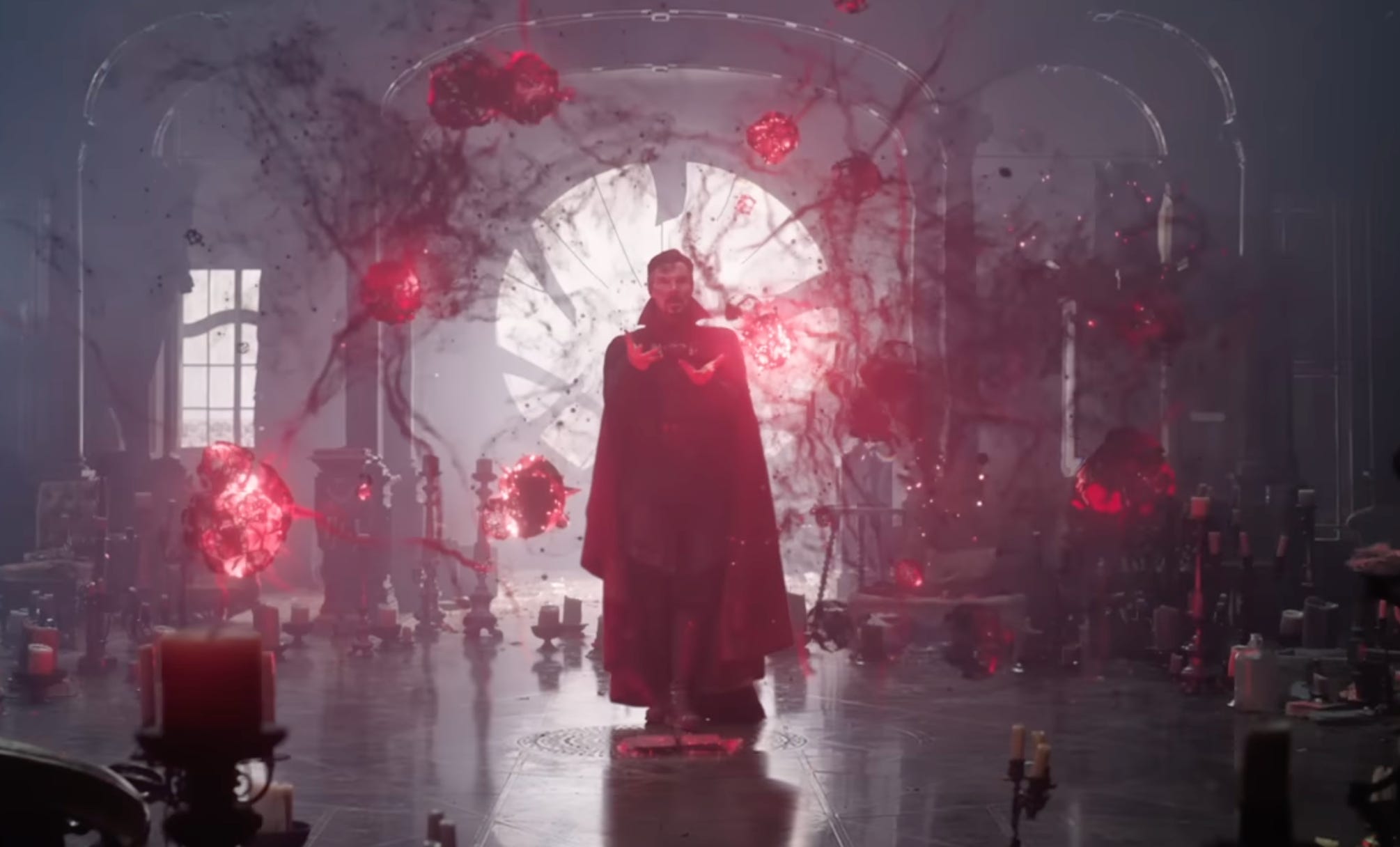
Doctor Strange rescues America Chavez—a teen who can travel throughout the multiverse—from demons; he then figures out that Wanda Maximoff (the Scarlet Witch) has been corrupted by the Darkhold and is the real person after Chavez. Wanda demands Strange turn over the teen. When he refuses, Wanda attacks Kamar-Taj and captures Wong, forcing Strange and America to escape through the multiverse. When they land on Earth-838, they are arrested by the Illuminati (Professor X, Reed Richards, Captain Carter, Captain Marvel, Black Bolt, and Mordo). Wanda dreamwalks into the body of her variant from 838, kills every member of the Illuminati, captures America, and sends Strange to a ruined reality. Strange uses the Darkhold to dreamwalk into the corpse of a deceased variant (that was brought to his universe by America). America learns to control her abilities and shows Wanda the way she terrifies her sons from an alternate universe, which gets Wanda to destroy the Darkhold (and herself at the same time—though we never see a body). America stays in Strange’s universe (Earth-616) to train at Kamar-Taj; Strange grows a third eye, and in the mid-credits scene is recruited by Clea to fix an incursion.
The idea of dreamwalking is one of the scarier parts of the film (that and Wanda walking around like the girl from The Ring—which I have never seen, but those scenes from the trailers showed up before I could close my eyes), but it is also one of the most important. “Dreams are windows into the lives of our multiversal selves.” This line by Doctor Strange reframes sleep, dreams, and nightmares in the MCU. Sorcerers and variants tap into the wider multiverse in this psychological way, making me wonder about the role dreamwalking will play in Doomsday.
“You break the rules and become a hero. I do it and I become the enemy. That doesn’t seem fair.” Wanda delivers this line to Doctor Strange, highlighting the double standard between the events of WandaVision and Spider-Man: No Way Home (and maybe even Infinity War when he gave away the Time Stone to “save the day” and basically let Thanos win in the hopes that Endgame would happen). Strange did it as a favor and out of duty, while Wanda did it out of grief. Strange is allowed to be the hero in his movie, and Wanda is turned into the villain. I’m not saying that Wanda didn’t kill a bunch of people (like the entire Illuminati from Earth-838) and take over the life (and body) of one of her variants, but she isn’t wrong—Strange rewrites reality and it’s a noble sacrifice; she does it and she’s crazy.
Even if it was scarier than I preferred, it was still important to rewatch Multiverse of Madness. The introduction of incursions (hugely relevant in Doomsday), multiversal travel, variants (seeing the Illuminati on screen, even though they were all brutally murdered by Wanda, was awesome), and dreamwalking are all likely to play some sort of role in Doctor Doom’s plan. As worlds collide in Doomsday, and our heroes (and villains… and anti-heroes) are forced to make universe-altering decisions, who is going to break the rules? How are they going to be judged for it?
Disclaimer: All images and characters are the property of their respective copyright holders and are used here under Fair Use for analysis and commentary.