


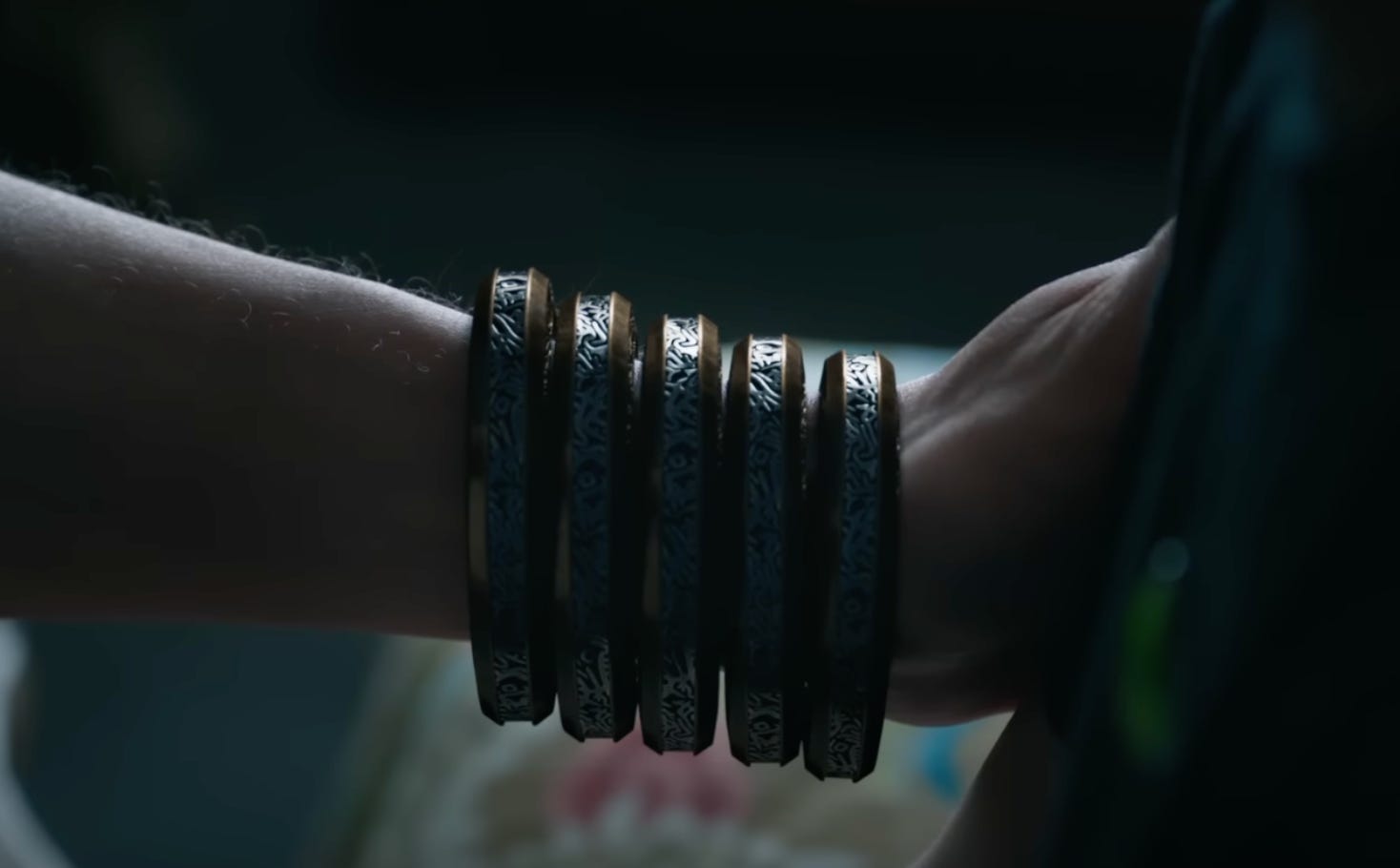
Spoiler Warning: We are spoiling Shang-Chi and the Legend of the Ten Rings and the entire MCU continuity. If you aren’t caught up, or don’t want Avengers: Doomsday to be spoiled (even though I have absolutely no idea about what will happen in that movie), stop reading now or accept the risks.
Who were the Ten Rings sending a beacon to (and why do I think the answer to that question is different now than it was when I first asked it five years ago)? That was the biggest question I had the first time I watched Shang-Chi, and every time I’ve watched it since. I’m not sure, but this could be the most important thing in the movie in relation to Avengers: Doomsday (especially considering Doctor Doom wasn’t even supposed to be the big bad here—Kevin Feige pulls yet another rabbit out of his hat). The mastery with which Marvel drops breadcrumbs in its movies to connect them is second to none (some pay off like Thanos; others just simmer until Marvel can figure out what to do with them). Some people said the Ten Rings post-credit scene didn’t pay off, but Marvel was just letting it sit there until they could use it for a huge reveal.
After ruling a criminal empire for centuries using the Ten Rings (immortality and unmatched power), Xu Wenwu falls in love with Ying Li, a guardian of the mythical Ta Lo (just a place in another dimension/parallel universe), gives up violence and has two kids—Shang-Chi and his badass sister, Xialing. Ying Li is murdered by Wenwu’s old rivals which has Wenwu break bad again, put the rings back on, get revenge, brutally train Shang-Chi, have him go assassinate the people that killed his mother, driving him to San Francisco. Ten years later, Ten Rings mercenaries sneak attack Shang-Chi and steal the pendant his mother gave him, causing him and his friend Katy to go protect his sister in Macau (little did he know she is a bit of a boss, and runs her own underground fight club). Wenwu captures the three of them and tells them that their mother (who is dead) is calling to him from beyond the gates of Ta Lo and he has to save her. The three of them escape with the help of Trevor Slattery and his mythical friend, Morris, reach Ta Lo before Wenwu and learn that the gate is actually keeping the Dweller-in-Darkness trapped. Wenwu gets to Ta Lo, attacks everyone, releases the demon and is killed by the demon, but not before he can pass the Ten Rings to Shang-Chi. Wielding the Ten Rings and backed by the people of Ta Lo, Shang-Chi kills the demon and is recruited by Wong (remember him from Dr. Strange?). Xialing tells Shang-Chi she is going to shut down their father’s criminal empire, but she secretly takes it over. In the post-credits scene, Wong, Captain Marvel, and Bruce Banner are talking to Shang-Chi and Katy about the Ten Rings, that’s when Wong tells them about the beacon.
Shang-Chi (the character, not the movie) is the only new character from Phase Four, Five, or Six to actually be recruited into the Avengers—in that scene with Wong, Captain Marvel, and Bruce Banner, Bruce tells him, “Welcome to the circus,” and Wong tells him and Katy that their lives will “be like nothing they’ve ever experienced before.” Some other characters seem like they will be mainstays in the MCU (Yelena Belova, John Walker, Sentry—basically all of the New Avengers), but none besides Shang-Chi has actually been welcomed to the real Avengers. So Shang-Chi is an essential introduction and origin story for a character that will be fighting as an Avenger (probably), with the mystical and powerful Ten Rings, against Doctor Doom.
The introduction of Ta Lo and the multiversal pocket dimensions laid the groundwork for the multiverse concepts from Phases Four and Five in the MCU. Understanding that these places exist outside the primary timeline of the MCU provides foundational lore for the collision of worlds, variants, and incursions that will drive Doomsday. Ta Lo expands the multiverse beyond just branching timelines with mythological pocket dimensions tied directly to the main timeline and sets the precedent for alternate realms existing in the same timeline, parallel to the prime universe (very confusing, but this isn’t even as confusing as all the science talk from Loki). With worlds and timelines colliding and fighting in Avengers: Doomsday (or being destroyed and pitted against each other by Doom), Ta Lo and other pocket dimensions could act as a type of safe haven for our heroes, anti-heroes, and villains fighting each other—or just trying to survive.
When Shang-Chi was released back in 2021, we lived in a very different world. We were still in the middle of COVID and Kang was being teased as the big bad of the next Avengers (he was later confirmed as the big bad before being replaced by Doom because of some… unfortunate real life circumstances). So who the beacon was originally contacting in Shang-Chi is different than who the beacon will be contacting in Doomsday. In a world where Kang is no longer the main villain of the multiverse, what can an ancient, interdimensional signal mean for Doctor Doom? While Shang-Chi was meant to be a key part of the MCU moving into The Kang Dynasty, Kevin Feige pivoted to Doom, who is a natural fit for the mysticism and futuristic science, and still managed to keep Shang-Chi a key figure.
So while every beat of Shang-Chi and the Legend of the Ten Rings might not be mandatory viewing before Doomsday, understanding a lot of what came out of Shang-Chi definitely is. The Ten Rings offer god-level power and immortality—they are sending out a beacon to someone, somewhere. Ta Lo introduces us to pocket dimensions that could possibly be the key to our heroes’ safety in Doomsday. Shang-Chi is recruited to the real Avengers (not the New Avengers) and welcomed to the circus. Now that you know all of this, you are that much closer to being ready for Doomsday in December.
Disclaimer: All images and characters are the property of their respective copyright holders and are used here under Fair Use for analysis and commentary.